In modern manufacturing, productivity no longer depends solely on production lines, but on how smoothly the entire operation runs. One of the most common bottlenecks in many factories is internal logistics—an area that consumes significant time and labor but is often overlooked.
While manual carts and forklifts rely heavily on human labor and are prone to errors, delivery robots are emerging as a more efficient solution thanks to their ability to operate continuously, accurately, and integrate with overall management systems.
Below are five of the most impactful and practical applications of delivery robots in manufacturing environments:
1. Supplying materials to production lines – Eliminating operational bottlenecks
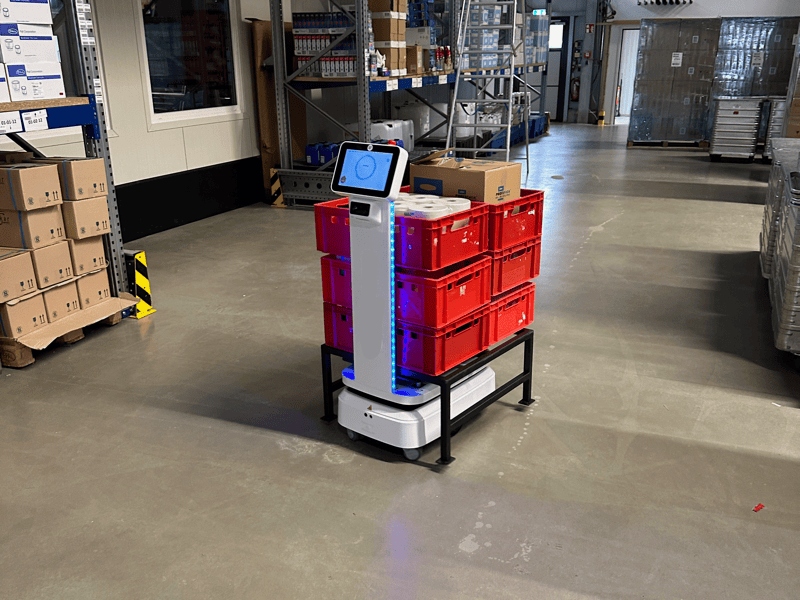
In many factories, material supply still depends on manual labor, leading to delays and inconsistencies. Delivery robots automate this process based on schedules or real-time system signals, ensuring materials are always available.
Key results:
- Up to 80% reduction in labor costs (10 robots replacing 15 workers, with only 3 supervisors needed)
- Increased delivery frequency from 4 to 10 trips per hour
- Accurate delivery of the right materials to the right locations with near-zero errors
Insight: When material flow is stable, the entire production line operates more efficiently.
2. Finished goods transportation – Stability and reduced damage
Finished goods transportation is often underestimated, yet it is a major source of product damage when handled manually. Robots ensure stable movement, avoid collisions, and improve accuracy in handling.
Key results:
- 40% reduction in damage rates (LCD manufacturing plant)
- Transport time reduced from 30 minutes to 12 minutes per batch (adhesive tape factory)
- Continuous 24/7 operation without fatigue or shift limitations
3. Warehouse operations optimization – Integrated with management systems
Delivery robots can integrate with Warehouse Management Systems (WMS) to automate inbound, outbound, and internal movements, creating a more synchronized operation.
Key results:
- 40% increase in handling efficiency, with error rates reduced to 0.2%
- One robot can replace up to 5 workers
- 15–18 trips per hour, reducing labor costs by up to 60%
Key point: Integration transforms operations from fragmented tasks into a unified physical and data-driven flow.
4. Hazardous material transportation – Enhancing safety
In industries such as pharmaceuticals and chemicals, minimizing human exposure is critical. Robots can fully replace manual handling in sensitive environments.
Real-world applications:
- Laboratories using robots to transport samples without human contact
- Pharmaceutical factories increasing efficiency by 30% while reducing contamination risks
- Chemical plants reducing spill incidents by 50%
5. Long-distance transportation – Scaling operations efficiently
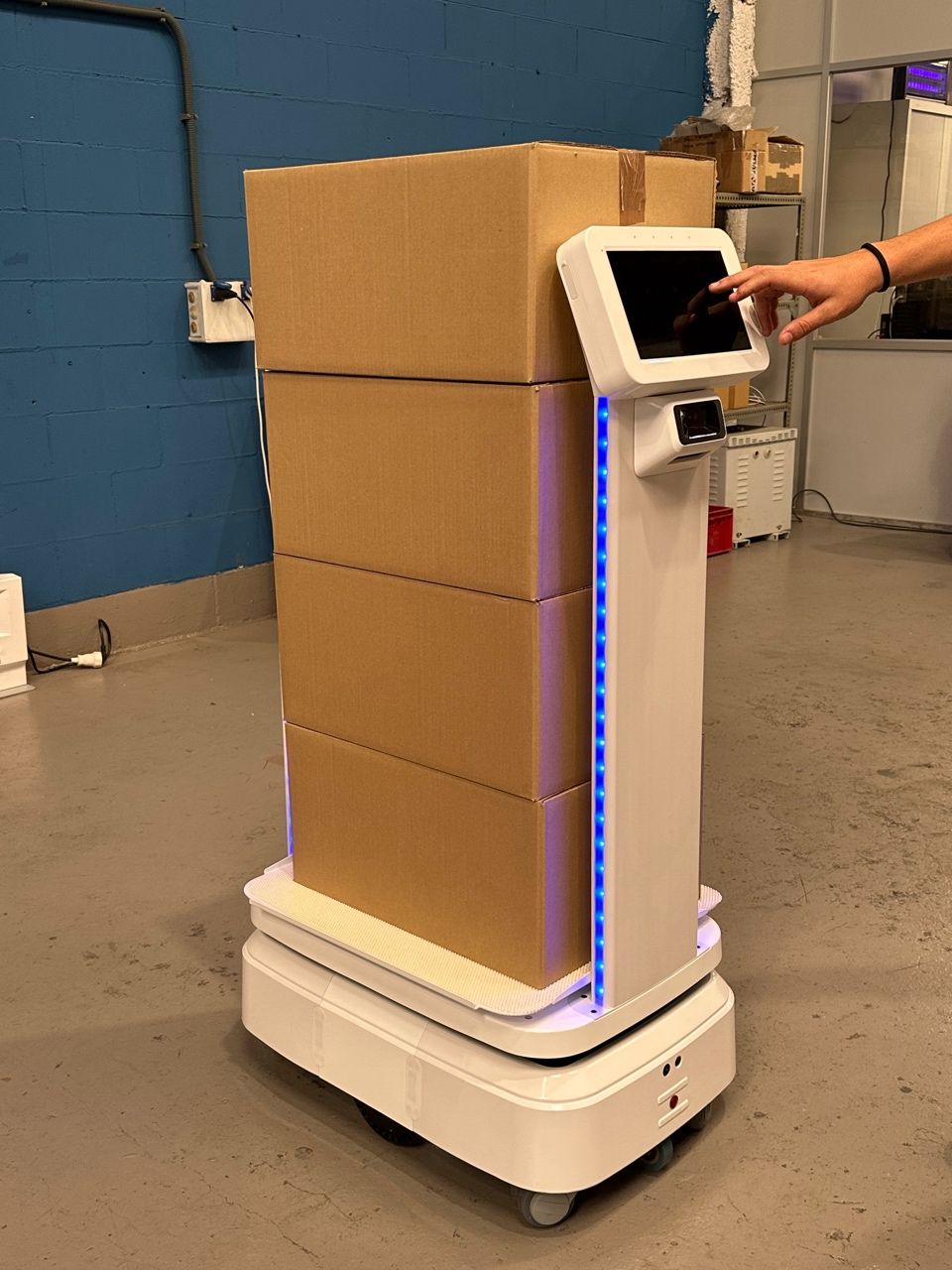
In large factories, transport distances can reach hundreds of meters. Relying on manual labor becomes inefficient and difficult to scale.
Key results:
- Speed of 1.5 m/s – approximately 30% faster than manual transport
- Over 200 trips per day
- Equivalent productivity of 5 workers
- Up to 50% reduction in internal logistics costs
Conclusion: Delivery robots as a new operational foundation
Implementing delivery robots is not just about replacing labor—it is about restructuring how factories operate:
- 30–60% increase in overall productivity
- 40–60% reduction in labor costs
- Improved stability and safety
- Reduced errors and product losses
- 24/7 continuous operation
More importantly, businesses begin to build a scalable automation foundation for future growth.
Want to evaluate whether delivery robots are suitable for your factory?
Contact PAN to assess your current operations and design a tailored automation solution that avoids misinvestment and maximizes efficiency.
CÔNG TY CỔ PHẦN THƯƠNG MẠI PAN
📍 142 đường B2, Khu đô thị Sala, TP.HCM
📞 (+84) 28 3840 2222
🌐 https://panrobotics.vn
📩 contact@pantrading.vn