In the field of mobile robotics (AMR – Autonomous Mobile Robot), accurate navigation is a critical factor that enables robots to move safely, avoid obstacles, and operate reliably in complex environments. To achieve this, robots must “understand” where they are and determine the most efficient route. This is where SLAM algorithms become a core technology.
What is SLAM? – The Foundation of Autonomous Robots
SLAM (Simultaneous Localization and Mapping) is an algorithm that allows robots to perform localization and mapping at the same time.
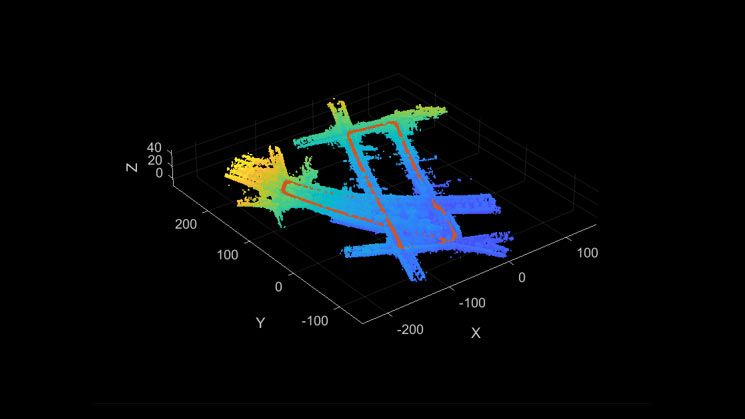
Unlike traditional AGVs that rely on magnetic lines or fixed maps, AMR robots use SLAM to continuously learn and update environmental maps in real time.
In other words, robots simultaneously “observe” – “map” – and “locate themselves” within their operational environment.
How Does SLAM Work?
A complete SLAM system typically includes the following components:
Data Collection Sensors
- 2D/3D Lidar
- Depth Cameras
- IMU (Inertial Measurement Unit)
- Wheel Encoders
Data Processing and Analysis
The robot continuously collects environmental data and compares it with previously stored information to identify obstacles, landmarks, and environmental changes.
Mapping
SLAM can generate multiple types of maps:
- Grid Maps
- Graph Maps
- 3D Point Clouds
Localization
- Determine the robot’s exact position within the generated map
- Estimate position using filtering algorithms such as KF, EKF, or Particle Filters
Why Is SLAM Important in Mobile Robotics?
Helping Robots Adapt to Dynamic Environments
In modern warehouses and factories, layouts frequently change due to moving pallets, shelves, and obstacles.
SLAM allows robots to update maps in real time without relying on fixed QR codes or magnetic guidance lines.
Precise Navigation in Narrow Spaces
Modern AMR robots can operate in corridors as narrow as 1.2–1.5 meters thanks to their ability to:
- Detect obstacles
- Predict movement trajectories
- Adjust speed dynamically in real time
Improving Operational Safety
SLAM algorithms enable robots to:
- Detect static and dynamic obstacles
- Slow down when approaching people
- Avoid collisions proactively
- Maintain safe operating distances
Optimizing Productivity and Routing
Robots can automatically choose:
- The shortest route
- Less congested areas
- The most efficient task sequence
This significantly reduces task completion time and improves operational efficiency.
Popular Types of SLAM Technologies
| SLAM Technology |
Key Features |
Common Applications |
| LiDAR SLAM |
Highly accurate and stable |
Warehousing, manufacturing, AMR robots |
| Visual SLAM (V-SLAM) |
Uses RGB-D cameras |
Service robots, office robots |
| Graph-SLAM |
High accuracy for large-scale maps |
Large industrial robotic systems |
| ORB-SLAM |
Efficient camera-based SLAM |
Reception robots, service robots |
Today, many advanced robotic systems apply Sensor Fusion technology — combining multiple sensors to improve navigation accuracy and operational stability.
Applications of SLAM in AMR Robots
Modern AMR robots use SLAM technology across various applications:
- Towing robots
- Pallet and box transport robots
- Autonomous lifting robots
- Inspection robots
- Service robots in hospitals, hotels, and offices
Thanks to SLAM, robots can safely operate in complex environments, crowded areas, and facilities where layouts frequently change.
SLAM – The Foundation of Future Mobile Robotics
In the era of smart factories and Logistics 4.0, SLAM has become a core technology that enables robots to:
- Operate more flexibly
- Reduce dependence on fixed infrastructure
- Be deployed more quickly
- Optimize operational costs
As SLAM technology continues to evolve, mobile robots are becoming smarter, safer, and more adaptable to real-world applications across manufacturing, logistics, and service industries.
If your business is looking for AMR solutions or autonomous robotic systems powered by advanced SLAM technology, Pan Robotics is ready to provide consultation and deployment support tailored to your operational needs.
PAN TRADING JOINT STOCK COMPANY
📍 142 B2 Street, Sala Urban Area, Ho Chi Minh City, Vietnam
📞 (+84) 28 3840 2222 - 0919 302 879
🌐 https://panrobotics.vn
📩 contact@pantrading.vn